
Consumer
You know that moment when you push open a toilet cubicle door, and it wobbles, or the panel feels a bit soggy at the edges? That's not bad luck. That's the wrong material behind the finish. Restrooms take a battering, water, constant hands, mop buckets, sometimes a fair bit of neglect, and whatever holds the partitions together has to survive all of it without falling apart in year two.
So, if you're specifying or buying materials for restroom partitions, here is what you need to know.
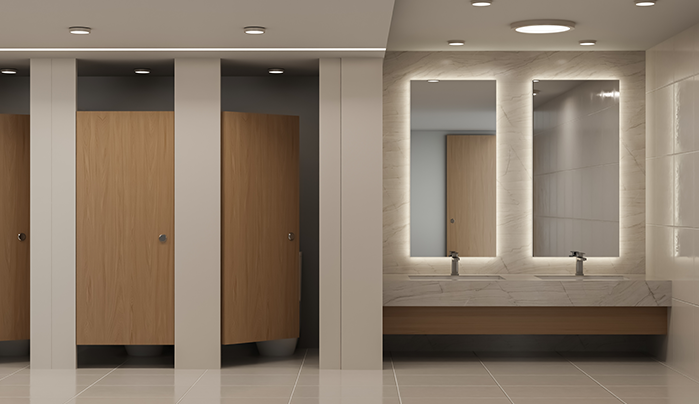
Here are a few materials that come up again and again once you start looking into this. A couple of them are old-school, a couple are newer, and others are just better suited.
This is basically a steel sheet with a protective coating baked onto it. Cheap and reasonably tough—that is exactly why so many older or budget washrooms still use it. The trouble is, the moment that coating scratches or chips, water sneaks underneath and rust does the rest. Not ideal for anywhere genuinely wet.
No coating required here; it's a solid plastic panel all the way through; nothing to peel off in a few years. It handles moisture well and cleans up in seconds. On the downside, it's heavier than people expect, and the design options are truly a little flat.
Sheets of resin-soaked paper are pressed under serious heat until they turn into something close to stone. Scratches, dents, even a lit cigarette barely leave a trace. It also resists bacteria, which is exactly why hospitals, gyms, and school toilets often go with it.
The toughest option on this list, and it looks sharp too. Handles water without a second thought and barely needs maintenance beyond a wipe-down. The catch? It costs more, and fingerprints or water spots show up more than most people expect from something so "low maintenance."
Built much like phenolic, layers of kraft paper bonded with phenolic resin, topped off with a decorative finish. It's compact, holds its own under daily wear, and comes in far more colours and textures than steel or plastic ever will. CenturyPly's CenturyCubicles range is built on HPL compact laminates, and it holds up well in busy washrooms.
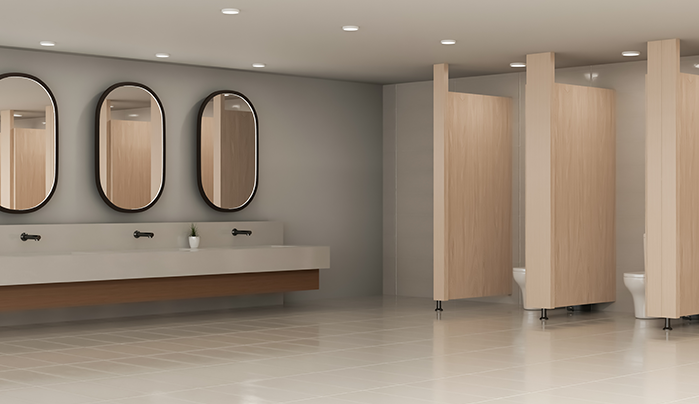
Knowing your options is one thing. Actually, picking one for your specific washroom is another matter entirely. Here are a handful of questions that will help you make the decision.
Constant mopping, splashing, and steam from nearby showers? If that's the daily reality, go for something that's genuinely boiling-waterproof and won't swell or warp. HPL and solid plastic both do this well.
A two-cubicle office loo doesn't need the same toughness as a school block or a shopping centre restroom that sees hundreds of people a day. For that kind of traffic, phenolic core or stainless steel will simply outlast everything else on the shortlist.
If colour and pattern matter, HPL comes in wood tones, solid colours, textures, and patterns that can actually match the rest of your interior. If you are after something plain and industrial, powder-coated or stainless steel blends into the background and does the job better always.
Powder-coated steel and HDPE are the budget-friendlier options here. Stainless steel and premium HPL cost more upfront but tend to save you money on repairs later. Remember, it's less about the sticker price and more about what you're avoiding down the line.
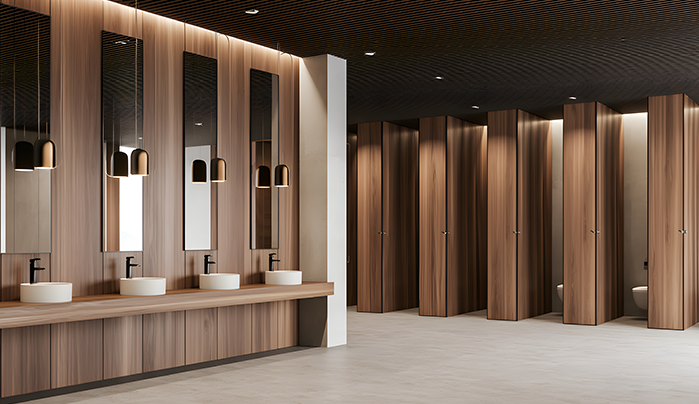
CenturyPly knows the difference between a brochure claim and a washroom that's still holding up after a decade of daily use. Their CenturyCubicles range is built from high-pressure laminate - the kind that shrugs off termites and borers, resists scratches and chemical spills, and keeps its finish even after years of being hosed down and scrubbed.
But these materials for restroom partitions is only half the story. CenturyPly also backs its products with real follow-through, and its Total Cover Warranty is a decent example of that. It goes beyond simply swapping out a faulty panel and instead stands behind the customer's larger investment if something genuinely goes wrong. That same approach runs through everything CenturyPly makes, including restroom cubicles.
If you want partitions that are actually built to last, with a brand willing to stand behind them, CenturyPly deserves a spot on your shortlist.
Stainless steel and phenolic core are the most durable materials for restroom partitions. Both handle moisture, impact, and years of heavy use without breaking down.
HPL and phenolic core work best for high-traffic restrooms. They resist scratches and moisture and handle constant daily use well.
Yes! Materials like HPL and solid plastic come in a wide range of colours and finishes, so matching a partition to your interior design is straightforward.
Loading categories...


