
Consumer
You walk into a bedroom. Something does not feel right. The wardrobe looks too dark. The walls feel cold. The room does not feel like yours. Small choices make a big difference. The finish on your wardrobe. The texture on your accent wall. The colour of your panels. Get them right, and the room feels calm and put together. Get them wrong, and you notice it every time you walk in. Laminates and panels offer a simple way to get these choices right. They give you options without making things complicated. This blog covers how to use laminates and panels to create a contemporary bedroom that actually works for you.
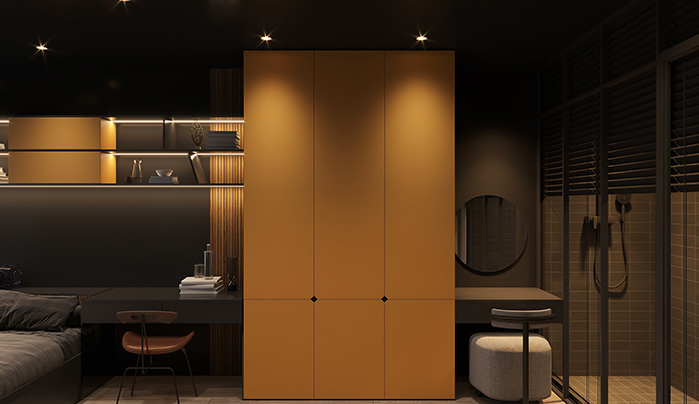
The contemporary bedroom aesthetic is built around restraint. Clean shapes, flat surfaces, and controlled colour. Laminates suit that approach because they produce a consistent finish across large areas with no grain variation or maintenance demands. Panels bring a different quality. Where laminates flatten, panels add depth through their geometry. Together, the two give a bedroom a layered finish that a single flat surface cannot achieve on its own.
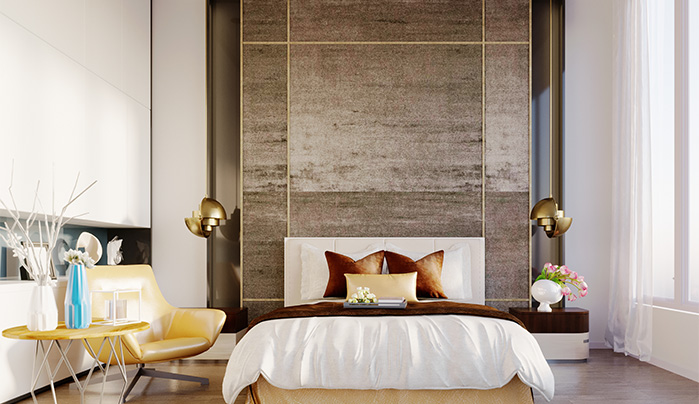
The wall behind the bed is where most contemporary bedroom designs begin. It faces the doorway, sets the character of the whole room, and draws attention without needing furniture or decoration to do the work.
Panels are not exclusive to the headboard wall. Either side of the bed, or running behind built-in storage, they extend the design across the full room without repeating the same feature twice.
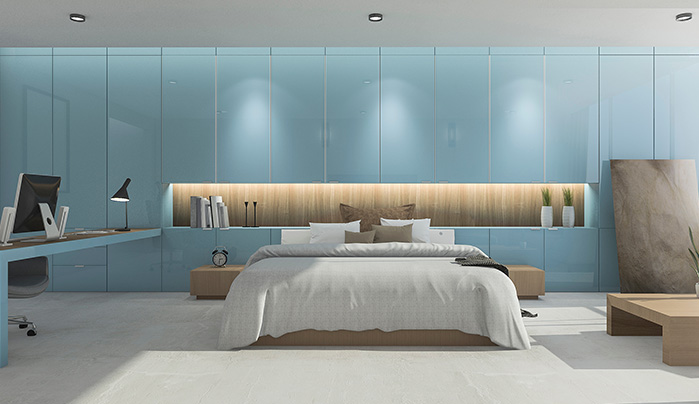
Wardrobe fronts take up more visual space in a bedroom than most people account for when choosing finishes.
Applying the same laminate across the wardrobe, bedside cabinets, and lower storage units pulls the room together, even when the furniture is not identical in form.
Panels work on ceilings too. A linear layout above the bed, running across the room's shorter dimension, changes how the ceiling reads and adds a directional quality to the space without extra furniture.
Timber-effect finishes at floor level bring warmth into a bedroom. Contemporary options available in the market have improved considerably in texture quality and grain realism, making them a practical choice for bedrooms where a wood feel is the goal.
Three matte surfaces in the same room tend to look flat. One surface that reflects light, one that absorbs it, and one that sits in between gives the room three distinct qualities across three planes.
Combinations that work well:
The textures need to sit comfortably next to each other, not match. That contrast is what gives a contemporary bedroom its depth.
CenturyPly makes both laminates and panels suited to bedroom applications.
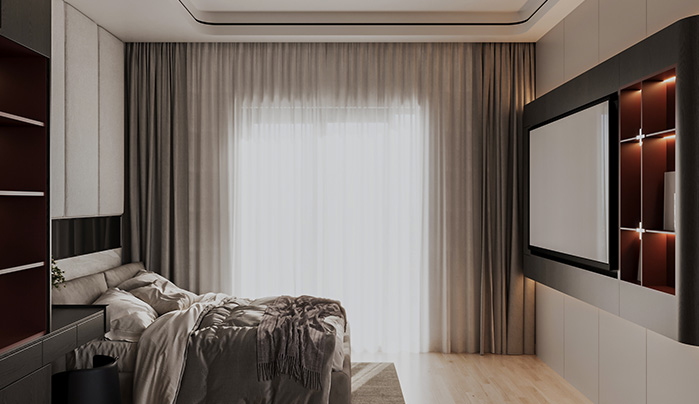
A well-designed contemporary bedroom does not need to be complicated. One laminate finish across the main furniture and one panel surface on a feature wall produce a room that feels considered and cohesive. CenturyPly offers both the laminates and panels to build that combination from a single source, which keeps the specification straightforward and the quality consistent throughout the room.
Matte finishes suit wardrobes and bedroom storage because daily handling leaves fewer visible marks on them than on high-gloss surfaces. Gloss finishes work better in well-lit rooms, where the surface picks up and reflects natural light across the space.
Any wall can take panels, but the headboard wall is the natural starting point because it faces the doorway directly. From there, panels can extend to either side of the bed or behind built-in joinery to carry the design further without it feeling repetitive.
Yes, and that combination is very common in contemporary bedroom design. Laminates finish the furniture, panels texture the walls, and together they create a layered result where each surface reads differently. The goal is contrast, not matching.
Laminate surfaces need very little upkeep in a bedroom setting. A damp cloth removes most marks, and no periodic sealing or polishing is needed. The durability depends on the laminate grade, so scratch-resistant specifications suit furniture that sees regular use.
Wood-grain laminates are printed onto a substrate, making them lighter and considerably less expensive than real veneer. Modern versions have improved in texture quality and grain depth, though the surface stays uniform rather than carrying the natural variation of real wood.
Loading categories...


