
Consumer
Most renovation budgets go toward furniture and lighting first, and materials get treated as an afterthought once the "real" decisions are made. In our experience, that's usually a backwards approach. A room can have the perfect sofa and still feel unfinished if the cabinetry underneath is cheap laminate slapped over weak plywood. Home ambience has far more to do with what's under the surface than most people assume.
If you're planning a renovation and unsure where the budget should actually go, here's how plywood, veneers, laminates, and wall panels each shape the feel of a room, and how to get the mix right.
Most people focus on colours and lighting and wonder why the room doesn't feel right. It's because it's rarely the colour. Even the best bulb doesn't help when you hang a pendant light fixture over a laminate that isn't exactly the right shade. Materials lie under all the other elements, and for that reason, they are not apparent until something feels wrong.
Texture matters more than people expect. Put a matte wood-grain surface next to a glossy one under the same light, and somehow they don't even look related, never mind that they're the exact same colour. Mood boards won't save a room. Picking materials that actually work for what the room does, that's the real job. The aesthetic comes after.
When people discuss home ambience, they rarely bring up plywood, and that's fair, because it's typically hidden under a laminate or veneer finish that will never be viewed. But that's exactly why it matters.
Trace any of that back far enough, and you land on the plywood. CenturyPly's Club Prime and Architect Ply are built for this exact kind of punishment that kitchens and bathrooms hand out daily. Steam. Spills. Constant moisture that would warp anything less.
Both are covered under Total Cover, CenturyPly's 10-year comprehensive warranty, so even the labour and material costs of a repair are covered if something does go wrong.
Several options also come with borer and termite resistance, which sounds like overkill until you're somewhere humid. Either way, whatever finish sits on top gets something solid to hold onto.
If any material earns its place in home ambience, it's veneer. Real wood, sliced thin and layered over an engineered core, and somehow that's enough to get the depth and grain movement of solid timber without the weight or the price tag that comes with it.
CenturyVeneers puts this to work mostly on pieces you're meant to notice: a feature wall behind the bed, a study table, cabinetry that should look put together instead of catalogue-assembled.
What's interesting is that the slightly uneven grain is the whole selling point. Laminate can fake the look from three feet away, but it can't quite fake a knot sitting in the wrong place or a colour shift halfway across the panel, as real veneers do. Those tiny inconsistencies are what tell your brain it's real wood, and that's where the warmth actually comes from, not the polish on top.
Laminates still get treated as the budget fallback, but that reputation is outdated. Here’s what's available today:
CenturyLaminates covers both ends well, the practical and the decorative. Kitchens and bathrooms get the moisture-resistant finishes. Living rooms and bedrooms lean on the rest of the range.
Wear is where the difference shows. A good laminate still looks right years after pricier materials have started to fade or chip. This matters because realistically, you don't want to redo a kitchen every three years just to keep it looking decent.
Plywood is the foundation, veneers and laminates are the finish, and wall panels are the shortcut. Put one up and a room reads differently almost overnight. A few options that tend to work well:
What panels do well is add depth to a surface that would otherwise just sit there. Living rooms, bedrooms and hallways benefit most, since a plain wall in those spaces tends to disappear next to everything else in the room.
Get the lighting right alongside it and a single panelled wall can do more for a space's home ambience than most people expect from one design decision.
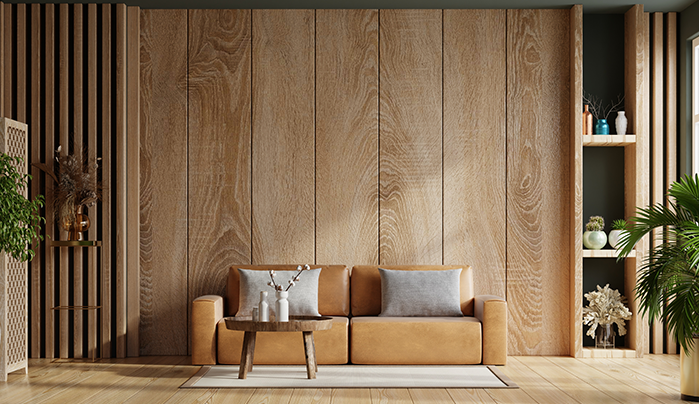
If you're looking to create a home that says "intentional", as opposed to a home with nice furniture, you'll want to lean on a veneer feature wall that sits next to laminate cabinetry, built to last over a plywood base. It's not about choosing one great material and building everything around it.
Be sure the plywood below is solid and that the laminate or veneer above is appropriate for the room. Then let finishing touches, a panelled wall, whatever it is, tie the whole thing together. This is genuinely the difference between a home that photographs well and one that actually feels good to live in, day after day.
Material choice affects home ambience the most, more than colour or furniture style. Texture and finish decide how a room feels under everyday lighting, not just how it looks in a photo.
Laminates work fine for most rooms and offer far more design range than they used to. Veneer suits spaces where you specifically want the irregularity and depth of real wood grain.
Yes, in fact, panels often help small rooms more, since they add depth and visual interest to a space that would otherwise feel flat and cramped.
Loading categories...


